The Finding

Of every 100 tonnes of cryogenic propellant dispatched from Earth toward Jupiter via relay chain, fewer than 3 arrive. This is not an insulation problem or a budget problem. It is a consequence of orbital mechanics and hydrogen thermodynamics that no relay architecture with passive cryogenic storage can overcome.

The covered wagon essay

The Framework

TIN computes delivery ratios for any scheduled transport network through a factorization: DR = ST × η. A single diagnostic, gamma, classifies networks as CLUSTER (path diversity helps) or TRAP (adding routes makes things worse). The framework screens commodity-dependent feasibility before hardware is committed. Validated across 290,000+ configurations spanning 8 planetary bodies and 5 terrestrial contact datasets.

The factorization is an arithmetic identity. The γ classification is derived from it. Configuration counts are simulation results. Policy implications are inferences from those results.

The Phase Diagram

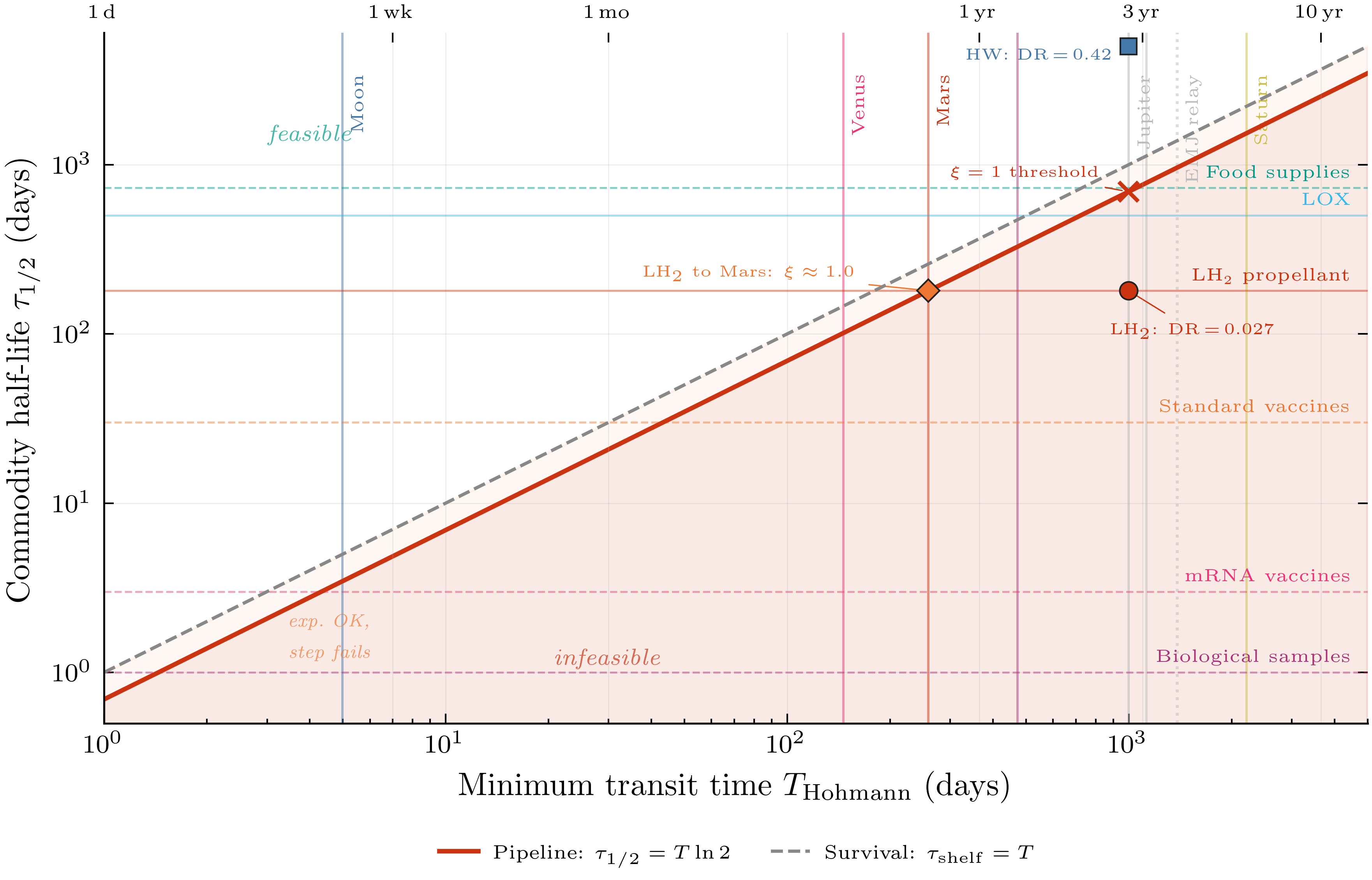
Commodity phase diagram showing feasibility boundaries by cargo half-life and transit time. Liquid hydrogen cannot survive any route beyond Mars. Hardware on the same route arrives at 42%.
Commodity feasibility depends on two numbers: how long the cargo survives (vertical axis) and how long the trip takes (horizontal axis). Liquid hydrogen cannot survive any route beyond Mars. Hardware on the same route arrives at 42%.

Interactive Tools

Papers

Code & Data

About

J. Councilman is an independent researcher applying percolation theory to scheduled transport networks. The core method: decompose aggregate metrics into their upstream causes before reaching for complex explanations. 290,000+ configurations tested, all code open-source.

ORCID · Contact